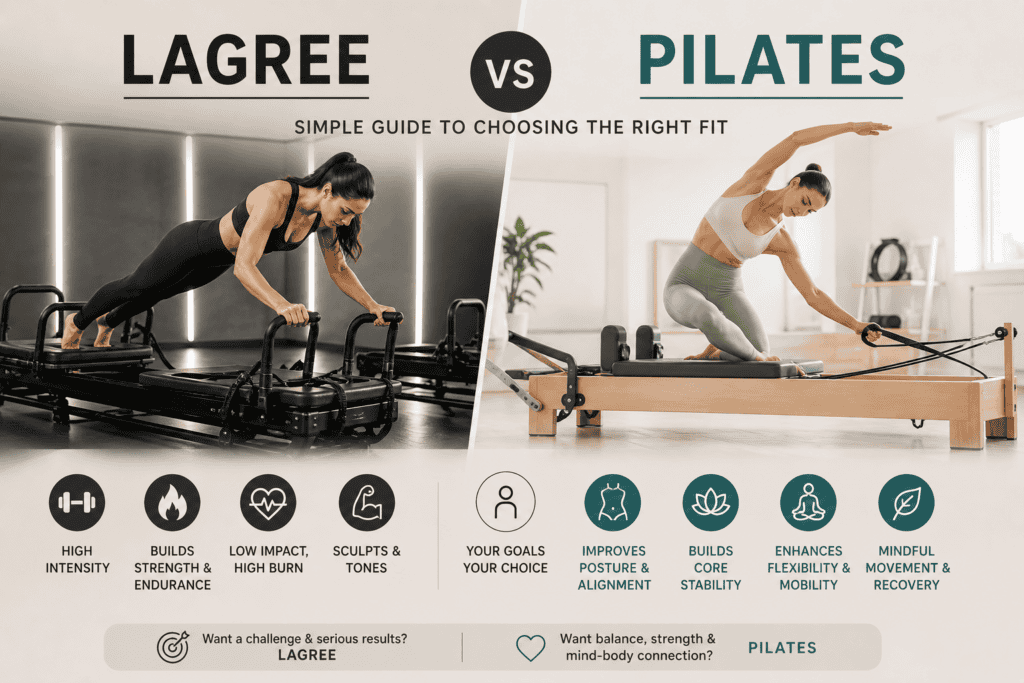
Trying to decide between Lagree and Pilates? Both methods aim for low-impact, full-body conditioning, but they differ in equipment, workout style, intensity, and outcomes. Lagree typically uses the Megaformer for high-intensity, continuous workouts that build strength and tone, while Pilates centers on core stability, mindful movement, and varied pace using the Reformer and other equipment. Choosing between them often comes down to your goals, fitness level, and desired experience.
Walk into any modern fitness studio, and chances are you’ll overhear a heated, friendly debate about Lagree vs Pilates. With glossy social media feeds touting visible abs or incredible transformations, these two methods tend to attract cross-shopping newcomers and longtime fitness buffs alike. Here’s where things can get a little muddy; to the uninitiated, they might look practically identical—sliding platforms, springs, and complex core exercises. Yet, as anyone who’s tried both can confirm, these are actually two distinct fitness worlds with their own philosophies, results, and diehard fans. Let’s demystify this often-misunderstood rivalry: what really sets Lagree and Pilates apart, and which one makes sense for different goals, bodies, and mindsets?
Here you can also learn about the differences between Yoga and Pilates.
Understanding Lagree and Pilates: Definitions and Origins
Every solid comparison starts with history. Pilates, the elder of the two, emerged from the ingenious mind of Joseph Pilates in the early 20th century. Originally called “Contrology,” Pilates evolved as a mindful system to build flexibility, balance, and—most famously—core strength. Its tools and philosophies now thread through countless fitness routines and rehab programs, earning a reputation for both its exacting discipline and accessibility across ages.
Fast-forward to the last couple of decades, and a new method started gaining ground. Lagree Fitness, founded by Sébastien Lagree, arose from a very human dilemma: why couldn’t a single workout blend Pilates’ low-impact vibe with true, sweat-inducing challenge? Taking cues from bodybuilding principles and borrowing (at first glance) the look of Pilates equipment, Lagree introduced the Megaformer: a long, spring-loaded platform bristling with handles and tension options. Suddenly, the studio landscape shifted, and “Lagree versus Pilates” became a talking point worth dissecting [1][2].
Define the origins any way you like—classical lineage versus innovative remix—the distinction comes down to much more than a clever rebrand.
Core Differences Between Lagree and Pilates
Methodology and Equipment Comparison
Here’s where most gym chatter turns from friendly to animated. The surface-level similarity—the moving carriage, the springs, the resistance—quickly falls away when examining how the two machines drive movement. Pilates classes often center on the Reformer, a versatile piece of equipment featuring a sliding carriage, adjustable springs, shoulder blocks, plus a footbar and a set of straps for a range of controlled, precise exercises. There’s almost a meditative rhythm in a classical Pilates session; think “lengthen out,” “steady breath,” “gentle resistance.”
Now, slot in the Megaformer—the heart of Lagree. Outwardly similar, but what a difference in attitude. The Megaformer cranks up the number of springs and expands what you can do horizontally and vertically, with different standing platforms, various grip options, and a fundamentally tweakable resistance system [2][3]. Most Megaformer classes rarely have you resting on your back; instead, you’re lunging, balancing, and gritting through long holds that have even pro-athletes grimacing.
- Pilates Reformer: Focuses on flowing, deliberate movement, typically in a supine (lying down) or seated position; allows endless variations but with rest intervals between sets.
- Lagree Megaformer: Offers greater exercise variety, increased spring resistance, and more positions (standing, kneeling, planking); almost no rest between moves for continuous tension.
No surprise that even among instructors, some affectionately refer to the Megaformer as “an advanced spaceship”—a nod to its complexity and range [1].
Intensity and Class Structure
Now, if you want a scenario: Imagine a typical afternoon studio slot. A Pilates class centers on control. Exercises build from gentle warm-up to gradual challenges, with instructors cuing breath and alignment; “Feel every vertebra,” a phrase regularly uttered. There are pauses—intentional, restorative—so the mind keeps pace with the body.
Lagree classes, on the other hand, hit the ground running—minus the actual running. After a swift instructor intro, you’re straight into relentless, slow, muscle-burning exercises that transition rapidly. The burn sneaks up, intensifies, then lingers. Rest intervals? Basically non-existent. Lagree worships “time under tension”—the longer your muscles hold out, the more they quiver, the stronger the effect [1][2].
- Pilates: Emphasizes balanced routines with rest, fluid transitions, varied intensity, and tailored modifications for individual needs.
- Lagree: Focuses on non-stop, continuous muscle activation using slow, deliberate movement and minimal transition time for maximal fatigue.
Most regulars walk out of Lagree sessions both spent and energized—“sweaty, shaking, and humbled,” as one instructor quipped [1].
Lagree vs Pilates Reformer Workouts
Stack a Lagree class up next to a Pilates machines and equipment class, and the vibe feels miles apart. Pilates reformer routines usually prioritize core stability, posture, and range of motion—each exercise built around alignment and precision, often emphasizing concentric and eccentric muscle control. Movements progress at varying speeds depending on the exercise or class focus.
Lagree reformer workouts use the Megaformer to ratchet up every factor—range of motion, joint stability, cardiovascular challenge, and muscular fatigue. There’s less choreography, more high-tension holding, and a relentless emphasis on pushing muscle groups to the point of exhaustion, but never at the expense of form.
| Aspect | Pilates Reformer | Lagree Megaformer |
|---|---|---|
| Main Focus | Core strength, balance, and flexibility | Strength, endurance, cardiovascular fitness |
| Pace | Varies; flowing transitions | Slow tempo per move, very fast transitions |
| Rest | Yes, between sets | Minimal rest, continuous movement |
| Intensity | Low to moderate (scalable) | High, even with light resistance |
With both methods, safe technique always matters; only the definition of “challenging” changes.
Benefits of Lagree vs Pilates: Results and Health Outcomes
Lagree vs Pilates for Toning and Strength
On the surface, both workouts claim to “sculpt” or “tone,” but the paths couldn’t be more different. Pilates, with its roots in rehabilitation, shines in building deep core strength, gently working the smaller stabilizer muscles, and improving postural alignment. Students often notice subtle but profound improvements in balance, coordination, and that coveted elongated muscle look favored by dancers and athletes alike [2][3].
The Lagree method swings the pendulum further. Drawing directly from bodybuilding concepts, Lagree systematically works for muscle fatigue—think longer holds, slower “time-under-tension,” and sequences that light up several muscle groups at once [1]. Clients report visible changes in muscle tone, especially in glutes, thighs, and abdominals, after a few weeks of consistent practice. There’s a reason the phrase “body shaking” comes up so often in Lagree circles.
Lagree vs Pilates for Weight Loss
Weight loss often enters the conversation around Lagree and Pilates, but here’s where realistic expectations matter. Pilates is superb for overall wellness, flexibility, and injury prevention, but on its own, burns fewer calories than high-intensity systems. That said, as flexibility increases and muscles become more toned, many people find themselves feeling, moving, and even looking leaner.
Lagree, designed specifically as a high-intensity, low-impact training method, cranks up metabolic demand. Quick transitions, full-body activation, and longer periods of muscle work mean higher calorie burn—often more than what’s typically achieved in a traditional Pilates session [2]. As a result, “Lagree vs Pilates for weight loss” leans in Lagree’s favor for those prioritizing fat loss as a central goal, especially when sessions are paired with healthy dietary habits.
Still, neither approach is magic. Only with consistency, mindful nutrition, and gradual progression do the most sustainable results stick.
Lagree vs Pilates Results: What to Expect
- With Pilates: Expect heightened body awareness, better posture, and noticeable improvements in flexibility and injury resilience after several weeks.
- With Lagree: Anticipate increased muscle definition, reduced body fat (over time), and cardiovascular conditioning, often alongside faster perceived results.
Momentum builds with both, but the pace and specializations differ. Those looking for a gentler approach to longevity often favor Pilates. Those hungry for fast, visible change—shaking thighs and all—walk away from Lagree talks unsatisfied until their next class [1][2].
Which Is Harder: Lagree, Pilates, or Other Methods?
Ultra Lagree vs Pilates Intensity
The running joke among those who’ve tried both? “Lagree will humble you.” Ultra Lagree, sometimes billed as the most advanced version of the method, is notorious for mind-bending slow tempo, extreme muscle fatigue, and innovative Megaformer moves that demand laser-sharp focus. It’s not just hard—it’s uniquely challenging, marrying high resistance with meticulous form, every second stretching your mind-body connection.
Traditional Pilates simply isn’t designed to be a burnout class. The hardest advanced Pilates routines certainly build heat and test core control, but few would describe Pilates as producing the same trembling exhaustion routinely seen after Lagree [1][2]. Both reward mastery—just on different scales of intensity.
Lagree vs Pilates vs Solidcore Comparison
If you’ve seen talk of Solidcore in fitness circles or on Reddit threads, you’re not alone—it’s a common addition to the comparison of Lagree vs Pilates vs Solidcore. Solidcore evolved as a Lagree-inspired franchise, borrowing heavily from Megaformer-style routines. For the average participant, Solidcore classes tend to feel very much like Lagree: slow, high-tension, group energy palpably high, music blaring, sweat flying.
- Lagree: Broadly considered more flexible (thanks to studio variety) and often more rigorous in original locations.
- Pilates: Remains more customizable—tailored for everyone from beginners to elite athletes and rehabilitation patients.
- Solidcore: Marketed as “Pilates redefined,” but let’s call it what it is: Lagree-style intensity, often in a boutique, high-energy setting.
The real difference between these three lies more in brand philosophy, class programming, and local instructor nuance than in fundamental movement patterns [3].
Lagree vs Pilates vs Barre: Key Differences
Add Barre to the mix, and minds usually leap to upright ballet-inspired classes pulsing to music. Barre draws from Pilates, dance, and functional strength—short, repetitive movements, but almost always done standing at a barre or using small props, with emphasis on endurance and posture.
While Pilates and Lagree dominate on equipment-based core work, Barre leans on “feel the burn” through small, isometric contractions using bodyweight or very light resistance. The “Lagree versus Pilates versus Barre” comparison mainly serves those curious about toning, not the mechanics of movement. In sum: Barre offers calorie burn through repetition, Pilates through controlled movement, and Lagree through sustained high-intensity intervals on the Megaformer. Think of them as cousins with distinctly different personalities at the fitness family reunion.
If you are curious about Yoga vs Pilates, check out: Yoga vs Pilates Retreat: Proven Ways to Choose Right in 2026
Lagree and Pilates: Suitability for Different Fitness Levels
Pilates for Ehlers-Danlos Syndrome and Special Populations
People managing Ehlers-Danlos syndrome (EDS)—a group of genetic connective tissue disorders—know that joint hypermobility and chronic pain complicate most exercise routines. Classical Pilates, with its hallmark focus on gentle joint stabilization, alignment, and individualized modifications, shows real promise for these populations. Pilates’ adaptable, mindful structure suits EDS sufferers by encouraging controlled, safe movement, limiting overstretching, and supporting muscle endurance—all crucial for enhancing day-to-day function [3].
Lagree, while low-impact, does not share the same rehabilitation tradition or programming flexibility. The fast transitions, upright nature, and relentless resistance can be problematic for joint instability and fatigue common in EDS or other chronic pain conditions. Here, Pilates is generally preferable, especially when overseen by an instructor experienced with special populations (editor-verified).
Choosing Studio Lagree or Pilates Based on Goals
- For beginners or injury recovery: Classical or contemporary Pilates usually makes the most sense, thanks to its scalability, attention to alignment, and instructor expertise.
- For those craving intensity, visible toning, and group energy: Studio Lagree or Solidcore environments appeal to people who thrive on teamwork, pumping music, and that “shaky muscle” sensation.
- For cross-trainers: Many athletes or fitness fans incorporate both, using Pilates for injury prevention or balance work, and Lagree for muscle fatigue and conditioning.
Local experience varies—a seasoned instructor and supportive community can make or break a studio selection, regardless of method.
For a more in-depth Pilates experience, you might consider joining one of the Pilates retreats in the UK.
Real User Experiences: Lagree vs Pilates Reddit Insights
Type “lagree vs pilates reddit” into any search bar, and you’ll unearth scrolls of personal stories and micro-anecdotes. Here’s where the community gives unvarnished feedback—think sweaty post-class photos, progress updates, and candid “I thought my legs would never stop shaking” confessions. The consensus? Many users find Lagree classes initially overwhelming but quickly addictive, appreciating visible muscle definition and the group-driven adrenaline it stirs.
Reddit threads highlight that those starting with Pilates often feel better prepared to tackle Lagree, already owning a sense of body awareness and alignment. Several chronic pain and EDS users, however, describe traditional Pilates as a lifeline, underscoring the dangers of diving into Lagree without prior experience or the right modifications. The line that comes up repeatedly: “Don’t underestimate either discipline—both require focus, and both can kick your butt in their own way.” Surprising, but speaks volumes: in fitness, as in life, context matters [3].
Frequently Asked Questions about Lagree vs Pilates
Is Lagree better than Pilates?
“Better” depends entirely on your priorities. Lagree excels in efficient, high-intensity strength and cardiovascular workout, often showing faster purely aesthetic results. Pilates is generally better for foundational core work, functional movement, and modifications for special populations. For the person tallying up calories burned and muscle groups fatigued, Lagree wins. For someone seeking longevity, balance, or recovery, Pilates ties it up—and sometimes pulls ahead [2][3].
Is Lagree the hardest Pilates?
Lagree isn’t Pilates, but it’s easy to see why people ask. While rooted in similar equipment heritage, Lagree classes are, on the whole, harder—more intense, continuous, and muscle-focused—than even advanced Pilates sessions. The Megaformer’s design, resistance levels, and programming carry its own brand of rigor, distinct from any Pilates lineage [1][2].
Is Pilates good for Ehlers-Danlos syndrome?
Absolutely. Pilates, especially under a knowledgeable instructor, adapts to the unique needs of Ehlers-Danlos syndrome and similar conditions. By emphasizing controlled movement, core stability, and alignment—never forcing overstretching—Pilates proves itself helpful for improving day-to-day function and reducing injury risk in people with joint hypermobility [3].
Can you get toned from Lagree?
Without a doubt. Lagree’s foundation is high muscle engagement and “time under tension”—that magical recipe for visible toning and muscle definition. With consistent practice and sensible diet, clients often notice increased tone in their arms, legs, and core within a few weeks [2].
How to Choose: Finding the Right Fit Between Lagree and Pilates
Sorting through the “lagree compared to pilates” conversation comes down to asking the right questions—and answering in terms of real needs, not marketing. Consider the following checklist:
- Assess current fitness level and any injuries or chronic conditions
- Decide if the priority is rapid body composition change, general fitness, or rehabilitation
- Think about preferred workout environment—calm and mindful vs. energetic and high-octane
- Try both methods (ideally with a private or intro class) before making a long-term commitment
Anecdotally, people often find the best results by blending both: using Pilates as a training backbone and supplementing with Lagree when craving a challenge. There are no wrong answers, just more informed ones.
Conclusion: Making an Informed Choice Between Lagree and Pilates
Key Takeaways: Lagree and Pilates Comparison
- Lagree and Pilates both provide full-body, low-impact strength training, but with striking differences in pace, principles, and outcomes.
- Pilates roots itself in alignment and core stability, suitable for every body and life stage—including special populations like EDS.
- Lagree thrives on relentless intensity and continuous high-tension movement for rapid strength, toning, and cardiovascular gains.
- The key factors for comparison of Lagree and Pilates: desired intensity, experience level, physical needs, and personal motivation.
Recommendations and Next Steps
Choosing between Lagree vs Pilates isn’t about picking a side, but understanding what best fits your body and goals right now. Beginners or those managing injuries likely start with Pilates for safer progression and tailored attention. Fitness enthusiasts hunting for a jolt of muscle-shaking challenge find Lagree a rewarding, sometimes humbling addition to their schedule.
At the end of the day, every individual’s ideal is different—and the smart choice is the one that’s sustainable, motivating, and leaves you feeling empowered. So book a class, trust your instincts, and let your own experience guide the way. No single method claims the last word in fitness; sometimes, it’s all about what keeps you coming back for more.
References
- Lagree Fitness. Lagree vs. Pilates. https://www.lagreefitness.com/lagree-vs-pilates. Accessed May 2, 2026.
- The Lagree Method. What’s the Difference Between Pilates and The Lagree Method? https://thelagreemethod.com/blog/whats-the-difference-between-pilates-and-the-lagree-method. Accessed May 2, 2026.
- Reforming Foundations. Lagree v. Pilates: What is the Difference? https://www.reformingfoundations.com/blog/lagree-versus-pilates-what-is-the-difference. Accessed May 2, 2026.