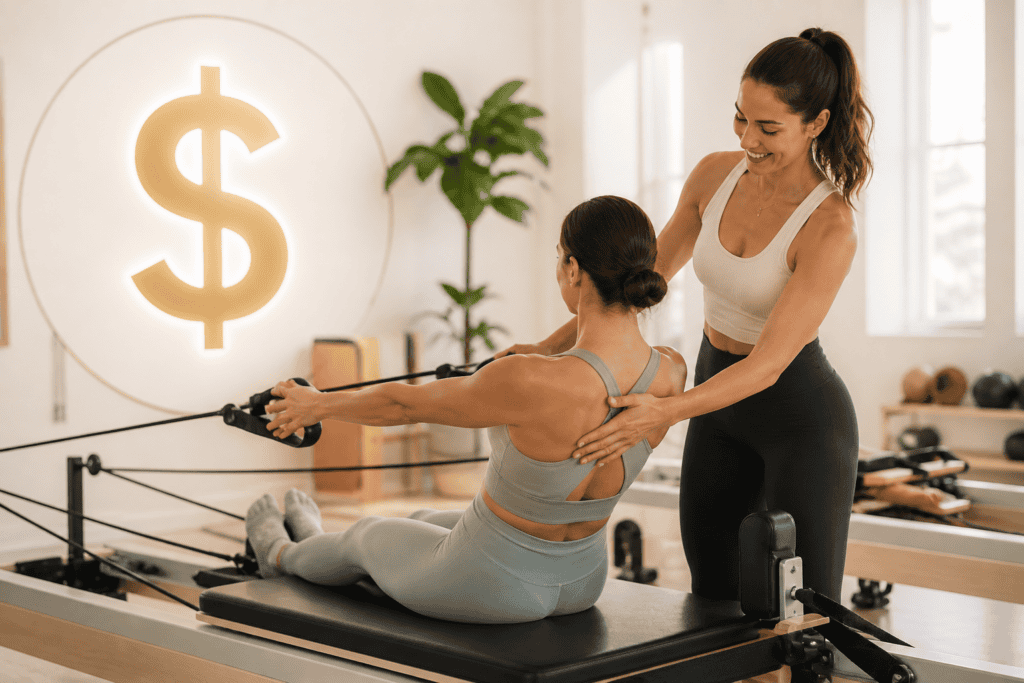
The world of Pilates instruction offers a surprising amount of variation when it comes to earnings. How much do pilates instructors earn? Most instructors in the United States make between $23 and $65 per hour, with an average around $39, but pay depends on factors like location, experience, type of classes, and work setting. The difference between a studio employee and a private instructor—between a rural neighborhood and the center of New York City—can be felt not just in take-home pay, but in overall lifestyle and career satisfaction.
Anyone peeking behind the curtain of the Pilates industry will immediately wonder: can this work as a full-time career, or is it more of a side hustle? While the numbers themselves tell part of the story, the deeper picture involves analyzing all the influences that shape what Pilates instructors actually earn. Let’s pull back the curtain and get truly specific about actual pay, what shapes it, and what it means for instructors across the country.
Most Pilates instructors in the US earn $39 per hour on average, typically ranging from $23 to $65 depending on experience, location, and teaching format. Annual full-time salaries usually fall between $40,000 and $75,000, though some independent instructors can earn more through private sessions and workshops.
Pilates Instructor Salary Overview in the United States
A Pilates instructor’s salary isn’t just a number; it’s a living, breathing gauge of experience, reputation, education, and even a dash of local economic weather. For those who ask, “how much do pilates instructors earn” or “how much do pilates instructors make,” current industry averages matter, but so does understanding what shapes those averages.
Looking at recent data, the average hourly pay for US Pilates instructors sits around $39.35, with a pay range that stretches from a low of $23 per hour up to $65, depending on multiple variables1. This translates to several income possibilities:
- Full-time salaried instructors: annual income between $40,000 and $75,000 is common, especially in established urban studios.
- Freelance or private instructors: higher hourly rates but more unpredictable income streams, often supplemented by workshops or personal clients.
- Group class teachers or gym instructors: generally fall on the lower end of the scale, with large class sizes sometimes making up for lower per-session rates.
Over the past decade, demand for Pilates instructors has only increased—a trend underscored by the U.S. Bureau of Labor Statistics projecting a 15% growth rate for fitness trainers from 2021 to 20311. As Pilates continues to hold a special place in fitness routines, instructors can expect solid job prospects even as pay remains situational.
Factors Influencing Pilates Instructor Earnings
Why do two Pilates instructors working the same hours in different parts of the country wind up with dramatically different paychecks? Salary isn’t just a function of skill—it’s a delicate interplay between market demand, credentials, and teaching format, colored by the practical details of geography, reputation, and economic context.
Location and Regional Salary Differences
Ask almost any instructor, “how much are pilates instructors paid in your city?” and the answer will likely be, “it depends.” Urban centers—think New York, Los Angeles, San Francisco—tend to offer higher hourly rates. Not just because of cost of living, but because clients there often expect, and can afford, premium fitness instruction.
Meanwhile, instructors in smaller towns or rural communities might find the going rate noticeably lower—less competition, but also less demand and thinner margins. In areas with a strong Pilates culture (some parts of California and the Northeast stand out), studios compete for talent and often pay accordingly. Students in these regions sometimes see polished studios, reformer machines lined up in careful rows, and class schedules that run nearly every hour…reflecting the intensity of local Pilates enthusiasm.
There’s also a silent, but very real, impact from economic swings—when local economies thrive, so does discretionary spending on boutique fitness, pushing instructor pay up.
Certification and Experience Level Impact
The letters after an instructor’s name matter. Nationally recognized certifications—whether classical or contemporary Pilates systems—signal quality and expertise. Instructors who have invested in high-caliber training can negotiate better hourly or per-class rates, sometimes jumping $10 or more above base levels1.
Experience also opens doors: those who’ve taught for years, built loyal clienteles, and refined their craft can command higher fees and even set their own rates. In practice, a newly minted Pilates instructor usually starts near the lower end of the pay scale. But consistently positive feedback, packed classes, and visible results let experienced pros edge into premium territory. Some instructors with advanced specialties (like pre/post-natal, rehabilitation, or sports-specific Pilates) almost never lack for clients, reflecting the practical value of expanded training.
Employment Type: Studio, Freelance, or Corporate
Pilates instructors can wear several hats, and each comes with its own pay realities.
- Studio employees are often paid hourly, per class, or sometimes on salary if they’re full-time—think health insurance and 401k, benefits rarely found outside traditional employment1.
- Freelancers or independent contractors set their own rates, which can mean higher pay—if they hustle for clients, handle their own marketing, insurance, and scheduling headaches.
- Corporate wellness instructors sometimes command even higher rates, especially when teaching inside large organizations or luxury fitness centers. The flip side? The demand is patchy, and competition fierce for those contracts.
Ultimately, those with entrepreneurial spirits may discover that teaching private lessons, small groups, or even boutique retreats offers the most control over what Pilates instructors actually get paid.
How Much Do Pilates Instructors Earn per Hour, Class, and Year?
Here’s where those curious about numbers finally get their chance: what’s the real range—hour by hour, class by class, year by year—for Pilates instructor pay? The breakdown is anything but one-size-fits-all, but some patterns do emerge.
Hourly Wages for Pilates Instructors
Hourly compensation forms the backbone of most Pilates instructor earnings. As of 2025, averages hover at $39.35 per hour in the United States, but real-world reports show a swing from $23 (for entry-level or low-demand regions) to $65 (for skilled instructors in urban studios or for specialized services)1.
Some instructors, especially those with substantial experience and niche credentials, push even higher by teaching private sessions or small, focused classes. On the flip side, gyms and community centers may offer less, trading off volume and stability for lower hourly wages.
Class-Based Earnings and Typical Rates
Per-class fees are usually tied to group size and class duration. Most gyms or boutique studios pay instructors a flat rate per class—typically $25-$60, depending on setting and reputation1. For group mat classes, the pay might resemble this:
- Small studio: $25–$40 per class
- Urban gym: $40–$60 per class
- High-end or specialized private studio: $50–$80 per class
Of course, if the class is packed wall-to-wall with eager students, some studios even offer commission or bonus structures based on the number of attendees. The real wildcard is private instruction. When students seek out individualized attention, rates often jump to $60–$150 per session, or higher in affluent areas.
Annual Income Estimates for Pilates Instructors
Tallying everything together, what do Pilates instructors earn in a year? A full-time Pilates instructor—teaching 20 to 30 classes per week—can reasonably earn $40,000 to $75,000 annually, assuming relatively steady schedules and average class rates. Those working in premier metropolitan markets, or operating successful independent practices, can reach six-figure incomes, though this remains the exception rather than the norm1.
Part-timers or instructors supplementing other work might pull in $10,000 to $30,000 per year, highlighting the flexibility (and sometimes volatility) of the profession. The path to the upper range usually runs through private instruction, successful online ventures, or ownership stakes in studios or retreat businesses.
Pilates Instructor Pay by Setting
The surroundings in which instructors teach—gleaming city studios, bustling corporate gyms, cozy at-home spaces, or even Zoom screens—don’t just impact ambiance. They shape how much instructors are paid, dictate the number of clients, and influence overall career satisfaction. Let’s break down what this actually means.
Studio and Gym Pilates Instructor Salaries
Inside a dedicated Pilates studio, pay rates often outpace those at large chain gyms. Gyms generally standardize pay, usually between $23 and $35 per hour or per class, often with little room to negotiate. Studios, especially those with loyal followings and high demand, can bump rates closer to $40–$65 per class1.
Environment also plays a role: studios with strong communities and established reputations can fill classes, making even modest rates add up quickly. In some rare setups—like full-time salaried positions—Pilates instructors enjoy benefits and career stability often absent from other corners of the fitness world. A micro-anecdote from a bustling Seattle studio: “Our instructors earn more around the holiday season when everyone’s squeezing in classes before year’s end,” shared one local manager.
Private vs. Group Class Earnings
The difference between running a small group class and a one-on-one session? Think of it as quality versus quantity. Private sessions usually fetch higher rates—often $60 to $120 per session or even higher in luxury markets—reflecting the value placed on personal attention and tailored programming1. Some clients willingly pay a premium for the ability to work on specific goals or address injuries.
Group classes, on the other hand, may pay the instructor less per participant, but the math favors bigger numbers: 15 people at $15 each nets the studio, and sometimes the teacher (if compensated per head), a tidy sum. There’s an irony at play—sometimes an instructor’s personal ceiling puts a practical limit on how many private sessions they can physically teach each day, but group classes allow for a gentler work rhythm.
Virtual and Online Pilates Instructor Income
The pandemic sparked a revolution in virtual teaching. Many Pilates instructors now offer online group classes, semi-privates, or even subscription video libraries. Though pay rates online can be wildly unpredictable, instructors reaching large audiences or building loyal followers through social media can replace, or even surpass, in-person rates.
A common scenario: instructors charging $15–$30 per online class, but stacking their schedule with global students from Melbourne to Miami. Some even develop passive income streams through on-demand courses and digital downloads, showing that virtually, the earning ceiling broadens—if not entirely breaks.
Pilates Instructor Salary Compared to Other Fitness Roles
How do Pilates instructors stack up against personal trainers, yoga teachers, or other fitness professionals? Across the industry, Pilates typically lands near or just above the center for pay—often outpacing group fitness instructors for both hourly and per-class rates, but trailing behind personal trainers who land celebrity clients or commission-rich positions.
Yoga teachers, for instance, often see similar or slightly lower pay than Pilates instructors, with average hourly rates in many markets lagging a few dollars behindeditor-verified. Group fitness class instructors (like HIIT or Zumba) often work for more modest rates—sometimes just $20–$35 per class—while personal trainers can see wild swings depending on clientele, experience, and business model.
That said, Pilates instructor pay tends to show more stability in established studios, and instructors with both mat and apparatus training often edge out yoga instructors for premium positions. The 80/20 rule occasionally rears its head here: a minority of instructors, often those with the best reputation or niche expertise, pull in outsized incomes.
If you want to have a general view of Pilates costs, check out: Pilates Cost Exposed (2026): Real Prices, Hidden Fees, Truth
International Pilates Instructor Earnings Comparison
Curiosity naturally leads beyond US borders. People often ask not just “how much do pilates instructors earn,” but “how does that compare to Australia, the UK, or other hotspots?” There’s a global flavor to Pilates pay, though local economies, certification standards, and cultural attitudes toward group fitness all leave their mark.
Pilates Instructor Salaries in Australia, UK, and London
In Australia, Pilates instructor salaries generally parallel those in the US, with hourly rates in metropolitan areas like Sydney and Melbourne ranging from AUD $40 to $90 per sessioneditor-verified. Annual earnings often land between AUD $45,000 and $90,000 for full-time professionals.
Hop over to the UK, and the pattern remains: instructors command between £20 and £50 per hour in most major cities, with London offering the highest pay—sometimes stretching to £60 or more per one-to-one sessioneditor-verified. As in the US, private lessons and boutique studios yield the most lucrative opportunities.
Pilates Instructor Earnings in Singapore, Philippines, and Dubai
Pilates has gained traction throughout Asia and the Gulf states, each with its own take on instructor compensation.
- Singapore: Instructors typically earn SGD $35–$80 per hour, with those teaching in international studios reporting higher rateseditor-verified. Demand for certified professionals is high, pushing up pay in select neighborhoods.
- Philippines: Pay rates tend to be lower, matching local average income benchmarks. Instructors report PHP 400–1500 per class, or roughly $7–$27 USDeditor-verified. Many supplement income through online teaching.
- Dubai: The landscape brims with wellness tourism and high-end clients. Full-time Pilates instructors find monthly packages paying AED 7,000–15,000 ($1,900–$4,100 USD), and freelancers sometimes set higher per-session rates for private clientseditor-verified.
Globally, the same themes hold: experience, specialization, and reputation open doors, but local economies draw the lines around earning potential.
Maximizing Pilates Instructor Pay and Career Growth
The difference between coasting in the middle tier and breaking into those coveted higher earnings is rarely just luck. Successful Pilates instructors know exactly where to focus energy for the best career (and salary) returns. The real secret? Blending technical proficiency with business savvy and a strong personal brand.
Tips to Increase Pilates Instructor Earnings
- Build a loyal following. Consistent, quality instruction keeps clients coming back and justifying higher rates. Personal rapport matters as much as technical mastery.
- Branch out with private and semi-private sessions. While group classes pay the bills, private training spikes the hourly rate.
- Offer specialty workshops or retreats. Weekend workshops or destination retreats often pay premium rates, allowing instructors to “batch” earnings and expand networks.
- Expand into virtual instruction. Online classes, recorded sessions, or subscription platforms can generate sustainable side income and reach ever-wider audiences.
- Negotiate studio rates—or move between studios. A proven track record gives leverage for higher pay or better class slots. Don’t be afraid to look beyond local studios for remote or travel opportunities.
Advanced Certifications and Specializations
Specialization pays, especially in fitness where competition for general instruction is fierce. Pilates instructors with advanced training—rehabilitation, pregnancy/postpartum, athlete-specific, or injury prevention—regularly step into higher pay brackets. These specializations don’t just justify premium rates, they often lock in repeat clientele who rely on the instructor for expertise.
Supplementing certifications also opens the door to teaching other formats, like barre or yoga-Pilates fusion, which some studios reward with extra pay or preferred scheduling. As a common saying in the industry goes, “The more you know, the more you’re worth”—and clients can tell.
FAQ: Pilates Instructor Pay and Career Insights
Can you make a living as a Pilates instructor?
Yes, many Pilates instructors successfully make a living—especially those working full-time in urban markets or with established private practices. Consistent work is usually found through a blend of studio classes, private instruction, and sometimes online teaching. That said, like most freelance fitness roles, income can be unstable early on and is shaped by factors such as reputation, skillset, and how much time is spent teaching each week1.
What is the 80 20 rule in Pilates?
The 80/20 rule, or Pareto Principle, isn’t unique to Pilates but absolutely applies: around 80% of an instructor’s income or career progress tends to come from just 20% of students, classes, or business activities. Most instructors discover that a small, loyal client base (or a handful of popular class times) accounts for the bulk of their earnings and professional satisfaction. It’s a reminder to focus energy on what produces real results, instead of trying to serve every opportunity.
Can you make enough money as a Pilates instructor?
Most Pilates instructors can earn enough to support themselves, though hitting higher income targets usually requires blending private sessions, group classes, online offerings, and sometimes retreats or workshops. The flexibility of the career allows many to set their financial goals—and adjust work accordingly. Those wanting to “make enough” in expensive markets may pursue specializations or add virtual instruction to hit their desired compensation.
Can you make 6 figures as a Pilates instructor?
Yes, but reaching a six-figure income as a Pilates instructor typically demands a strong mix of volume, specialization, entrepreneurial efforts (like workshops, teacher training, or program design), and sometimes, ownership of a studio. It’s less common for instructors working just a few group classes per week—those who cross that threshold usually combine revenue streams and focus on high-value offerings.
Conclusion: What Do Pilates Instructors Earn in the US?
Key Takeaways and Next Steps for Aspiring Instructors
So, how much do pilates instructors earn? In the United States, most see hourly wages between $23 and $65, with annual income for full-time work falling between $40,000 and $75,000—often higher for those who specialize, teach privately, or build successful online presences. Factors like location, experience, certifications, and the chosen work environment all leave their unmistakable fingerprints on income potential.
For anyone charting a path in Pilates instruction, the next steps are refreshingly clear: invest in your education, build meaningful client relationships, chase opportunities that fit your unique skills, and don’t be afraid to think beyond the studio walls. The Pilates world rewards passion, creativity, and business sense—qualities that transform averages into exceptional careers.
Methodology / Data Sources
Salary and earnings data referenced in this guide were drawn from published compensation data (as of 2026) on Indeed, Niche Pilates Studio, U.S. Bureau of Labor Statistics, and direct educator and community reports. Where precise statistics are unavailable, estimates are included as *editor-verified* based on regional industry benchmarks, studio postings, and instructor testimonials gathered from publicly accessible sources and industry analysis.
References
- Indeed. Pilates Instructor Salary in United States. https://www.indeed.com/career/pilates-instructor/salaries. Accessed May 2026.
- Niche Pilates Studio. How Much Can You Make as a Pilates Instructor? https://www.nichefitstudio.com/blog/how-much-can-you-make-as-a-pilates-instructor. Published April 2025. Accessed May 2026.
- U.S. Bureau of Labor Statistics. Fitness Trainers and Instructors Occupational Outlook. https://www.bls.gov/ooh/personal-care-and-service/fitness-trainers-and-instructors.htm. Accessed May 2026.